- Apache 2.0
- No account
- Any model
- Runs on your machine
The engine, in your terminal.
Ask your question in the terminal. Inflexa reads your data, proposes a plan, runs each step in a sandbox on your machine and signs a record of how every result was made.
Recommended. Downloads a prebuilt binary.
curl -fsSL https://inflexa.ai/install.sh | bash
inflexa
Question: Which pathways separate responders from non-responders in GSE109142?
Plan: Responder pathways with confounder adjustment. Steps: QC and cohort audit, Confounder-adjusted DE, Immune deconvolution, IPTW sensitivity, GSEA, concordant only.
Findings: 688 pathways hold after the weighting; CXCL13 marks non-responders.
Signed record: verified.
Version 0.25.0. Apache 2.0. No account. Requires Docker or Podman.
- 20 open skill packs
- 19 specialist agents
- 28 biological and clinical databases, plus 5 literature and code services
- 73 reference datasets, downloaded and verified
- 27 top-level commands
- 5 install channels
From install to a result you can trace, in four steps.
Install
One command, with no sign-up and no sales call. It installs on your machine, and it is yours.
inflexaRecommended. Downloads a prebuilt binary.
curl -fsSL https://inflexa.ai/install.sh | bash
cd ~/data/GSE109142
inflexa
Start a new analysis in /Users/you/data/GSE109142? yes
Ask
Describe the biology you care about, in a terminal, in plain language. Inflexa inspects your data, reads the current literature for your modality, and proposes a plan before it touches anything.
inflexaQuestion: Which pathways separate responders from non-responders in GSE109142?
Inflexa proposes a plan, Responder pathways with confounder adjustment: QC and cohort audit, Confounder-adjusted DE, Immune deconvolution, IPTW sensitivity, GSEA, concordant only. It waits for your approval.
Sessions built from public datasets: GSE109142, PROTECT pediatric ulcerative colitis.
Run
Approve the plan and it executes in a sandbox on your machine. If your laptop dies mid-run, the workflow resumes where it stopped.
inflexaThe plan is approved and running: 1 of 5 steps completed (QC and cohort audit), and Confounder-adjusted DE, Immune deconvolution and IPTW sensitivity running side by side.
Read
You get scripts, figures, tables, and a report, and beside them, the record: which method, which parameters, which input file, which model. Ask any output where it came from and it will tell you.
inflexaFindings: 688 pathways hold after the weighting; CXCL13 marks non-responders.
Signed record: verified.
The six parts of the engine behind the four steps.
What the engine does.
The same engine runs in Inflexa Pro and Inflexa Cloud. Here it runs in your terminal, on your machine.
Method choices that fit your cohort.
An analysis agent reads the literature for your biology, evaluates the shape of your dataset, and designs a multi-step plan you can inspect and override. It reasons about which methods fit your cohort.
- Multi-method checks on request. Ask for consensus and it runs the methods side by side, then keeps the findings that agree.
- Built for small cohorts. In underpowered translational data, analytical choice alone can flip a conclusion; consensus guards against that.
- Every choice recorded. The plan, the parameters, and the agent's reasoning sit beside the results, where you can disagree with them.
Plan: Responder pathways with confounder adjustment. Steps: QC and cohort audit, Confounder-adjusted DE, Immune deconvolution, IPTW sensitivity, GSEA, concordant only.
Reports your translational team can use.
Tell Inflexa what story you need to tell: responder stratification, biomarker association, survival by signature, pathway breakdown. Inflexa assembles a navigable, interactive report in the same conversation as the analysis, with no exporting and no reformatting.
- Iterate in conversation. Ask for a different visualization or a tighter interpretation; every version keeps its provenance.
- Bound to the files. Every figure, table and headline value in a report is read from the file that produced it, and every citation is checked against the registries before it is printed.
- Ready to share. Hand it to translational leadership, clinical collaborators, or external partners as-is.
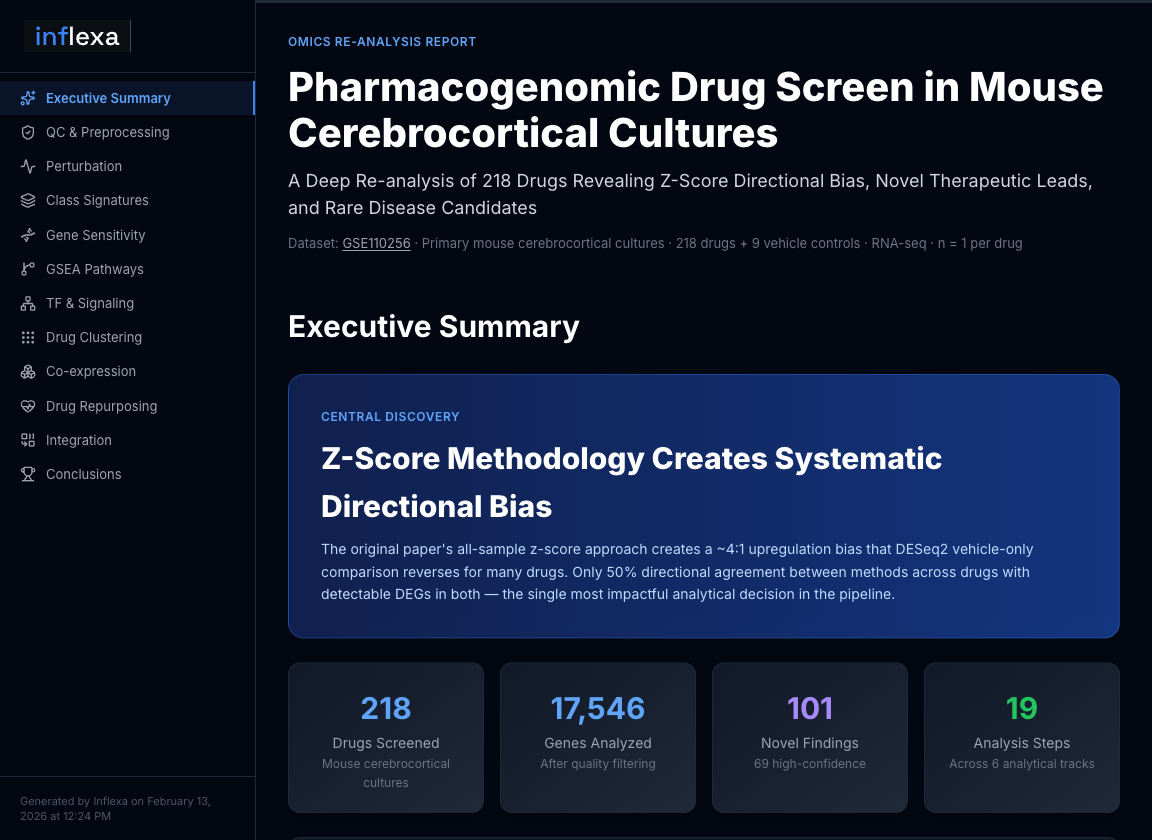
A real report, generated by Inflexa from the public GSE110256 dataset. This live copy is hosted on inflexa.ai, and the reports the CLI writes open from your disk.
Where did this file come from?
Inflexa records the answer as the work happens, and because the code that writes the record is open, you can check how it does it.
- Literature evidence chains. Targeted PubMed queries against each finding's hub genes, transcription factors, and pathways. Each finding is placed on the path to the clinic, from discovery through preclinical to clinical evidence, with the papers behind it.
- A signed audit trail. Each step's inputs, method, parameters and outputs are written as it runs. Each save of the record is chained by SHA-256 and signed with your Ed25519 key, so a later edit fails verification.
- File lineage you can walk. Files are entities keyed on path and content hash, so a file produced in one run and read by another stitches the two together on its own. Ask an output where it came from and Inflexa walks backwards to the inputs.
$ inflexa prov lineage output/pathways.csv
output/pathways.csv sha256:4c1f…9ab2
gseapy_prerank.py exit 0
output/de_joint_adj.csv sha256:8e07…13cd
limma_trend_de.R exit 0
output/log2tpm_filtered.csv sha256:a2d9…77e0
qc_audit.R exit 0
GSE109142 source
model anthropic/claude-opus-5 · step T2S1
signed ed25519:9f3c…a71b
$ inflexa prov verify
ok · chain intact · signature valid
The PROTECT run's record. The hashes are placeholders, and the script names and the pathway table's name are illustrative.
Queries the scientific record directly.
A model's memory of a gene can be out of date, or wrong. Inflexa checks the databases a computational biologist would open, live, and cites the one that answered.
Alongside them sit twenty open skill packs: encoded expertise for transcriptomics, proteomics, cheminformatics, drug repurposing, and the rest of translational analysis.
Your files stay on your machine.
Nothing is uploaded. Analyses run in a container on your own hardware, and outputs land in a folder you chose. What goes out is the model call, carrying the excerpts the agent reads, to the provider you chose, and the database lookups and web searches it makes for you.
What crosses the line
- Raw data and sample tables
- Intermediate files
- Results, figures and reports
- The signed record
Your model provider
prompts and excerpts, to the one you chose
Public sources
the lookups and web searches it makes for you
Point Inflexa at a model you host and the prompts stay on your network too.
What leaves your machine
- Stays:Your files and folders
- Stays:Your provenance record
- Stays:Usage data, with telemetry off by default
- Leaves:Model calls, to the provider you chose
- Leaves:Database lookups, to the public sources
- Leaves:Web searches, to public search engines
- Leaves:A check for a newer release, to GitHub
You do not have to believe this. The source is Apache 2.0. Read it.
Models supported today
The model is a component you supply, and swapping it is a line of config.
Sign in with your Claude, ChatGPT, Gemini or Qwen account, or point it at any Anthropic or OpenAI-compatible endpoint, including one you host.
Point it at a model you host yourself and your prompts never leave your network. The database lookups and web searches it makes for you still go out, and so does a check for a newer release, which you can turn off.
Inflexa records the model as an agent in the provenance graph, by provider and model name, for every step it drove. The usage ledger keeps the exact model that served each call.
You pay your provider directly. We never see the prompt, and we never take a margin on your tokens.
A real run on a public cohort.
The PROTECT responder analysis, run by the same engine this CLI installs.
From confounded cohort to druggable hypotheses.
A run on GSE109142, 206 patients: three mechanism-anchored hypotheses, one disqualification the direction analysis forced, and CXCL13 as the candidate the evidence kept returning to.
Read the case studyOnce PK, safety and clinical readiness are scored, rosiglitazone falls from the top biology score and sodium butyrate rises to first.
The same kind of analysis, by team:
The engine is open, and it stays open.
The planner, the sandbox, the skill packs and the signed record are Apache 2.0. Inflexa Pro adds a browser workspace and the Knowledge Plane service on top. Nothing moved out of the CLI to make Pro, and nothing will. If we vanished tomorrow, you would still have a complete tool.
Questions about the CLI.
Run it on your own data.
The Inflexa CLI is free and open source under Apache 2.0. Install it, point it at a dataset you care about, and read the code that produced the answer. Want a workspace? Inflexa Pro is a full workspace in your browser, served from your machine.