The open-source orchestrator for computational biology.
Runs in your terminal, on your machine, with the model you choose. Every result carries a signed record.
curl -fsSL https://inflexa.ai/install.sh | bashRecommended. Downloads a prebuilt binary.
Reading the cohort: 206 samples, 19,634 genes, week-4 remission label.
Therapy assignment is confounded with baseline severity, so a naive contrast would credit severity effects to response. Adjusting with IPTW and keeping only what survives across methods.
9 pathways concordant across all three methods. CXCL13 is the lead non-responder driver (E-value 2.12), independently supported by PMID 36378498.
lineage deseq2.R ← counts.tsv ← GSE109142model z-ai/glm-5.2signed ed25519:9f3c…a71b
Analytics
An analysis agent reads the literature for your biology, picks methods that fit your cohort, and runs every step end-to-end, recording the method, the parameters, and the model behind each one.
Reporting
Build interactive reports and dossiers from your analysis output, in one conversation. They come out as files on your disk: portable, version-controllable, and yours.
Provenance
Every claim traced to source: PubMed-cited literature, a signed audit trail, and file lineage you can walk. Ask any output where it came from.
Method choices that fit your cohort.
An analysis agent reads the literature for your biology, evaluates the shape of your dataset, and designs a multi-step plan you can inspect and override. It does not run a canned pipeline; it reasons about which methods fit your cohort.
- Multi-method consensus. When several methods apply, it runs them all and keeps only findings that hold up across approaches.
- Built for small cohorts. In underpowered translational data, analytical choice alone can flip a conclusion; consensus guards against that.
- Every choice recorded. The plan, the parameters, and the agent’s reasoning sit beside the results, where you can disagree with them.
I'll audit the cohort for that confound first, then run two independent contrasts and keep only what agrees.
Plan ready.
┌───────────────────────────────┐│ S1 RNA-seq QC + cohort audit │└───────────────────────────────┘│┌───────────────┴───────────────┐│ │┌───────────────────────────┐ ┌───────────────────────────┐│ S2 Confounder-adjusted DE │ │ S3 IPTW + causal sensiti… │└───────────────────────────┘ └───────────────────────────┘│ │┌───────────────────────────┐ ┌───────────────────────────┐│ S4 GSEA (concordant only) │ │ S5 Immune deconvolution │└───────────────────────────┘ └───────────────────────────┘
Two independent contrasts sit on a shared QC foundation:
- Confounder-adjusted DE. Responder vs non-responder at baseline, adjusting for severity and therapy arm.
- IPTW + causal sensitivity. Propensity-weighted contrast with an E-value robustness ranking, so a call has to survive the adjustment.
Only pathways concordant across both models are carried forward: in an n=206 cohort, analytical choice alone can flip a result, and consensus is the guard against that.
Approve as-is, or tell me which covariates to force into the model.
Executing run a9d491d9. QC first, then the two contrasts branch in parallel, with GSEA and immune deconvolution downstream. I'll pull the outputs and summarise once it lands.
Reports your translational team can actually use.
Tell Inflexa what story you need to tell: responder stratification, biomarker association, survival by signature, pathway breakdown. Inflexa assembles a navigable, interactive report in the same conversation as the analysis, with no exporting and no reformatting.
- Iterate in conversation. Ask for a different visualization or a tighter interpretation; every version keeps its provenance.
- Traceable by section. Each section links back to the analysis steps and source data that produced it.
- Ready to share. Hand it to translational leadership, clinical collaborators, or external partners as-is.
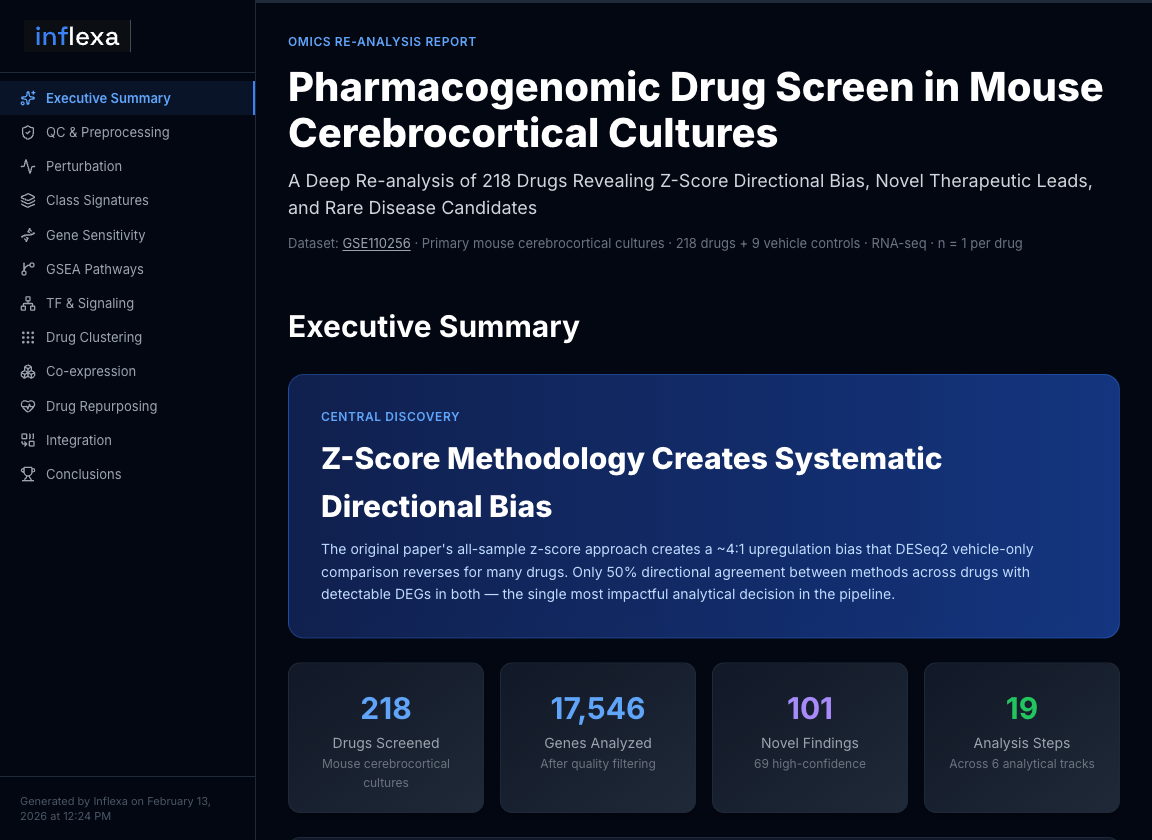
A real report, generated by Inflexa from the public GSE110256 dataset. Open the live report
Where did this file come from?
It is a simple question, and almost no scientific tool can answer it. Inflexa records the answer as the work happens, and because the code that writes the record is open, you can check it rather than trust it.
Targeted PubMed queries against each finding's hub genes, transcription factors, and pathways. Every claim links to its supporting PMID, tiered from basic biology to preclinical to clinical.
Each step, input, method, parameters, output, is written the moment it happens into a SHA-256 hash chain signed with your Ed25519 key. Alter an entry afterwards and verification fails. Tamper-evident, which is an honest word, rather than tamper-proof, which would not be.
Files are entities keyed on path and content hash, so a file produced in one run and read by another stitches the two together on its own. Ask an output where it came from and Inflexa walks backwards to the inputs.
Walking the provenance graph back from that file. Files are keyed on path and content hash, so reads and writes across runs stitch together on their own.
out/pathways.csv← fgsea.R sha256:4c1f…9ab2← out/de_results.tsv← deseq2.R sha256:8e07…13cd← data/counts.tsv← GSE109142 (source)
model z-ai/glm-5.2signed ed25519:9f3c…a71bverify ok · 47 entries · intact
Every step above was recorded by the execution layer as it ran: method, parameters, inputs, content hash, and the model behind each choice. The record is signed, so a later edit to any entry would fail verification. A third party can check it offline, with no account and no server.
Four steps, and none of them involve uploading your data to anyone.
Install
One command. No account, no sign-up, no sales call. It lands on your machine and it is yours.
Ask
Describe the biology you care about, in a terminal, in plain language. Inflexa inspects your data, reads the current literature for your modality, and proposes a plan before it touches anything.
Run
Approve the plan and it executes in a sandbox on your machine. If your laptop dies mid-run, the workflow resumes where it stopped.
Read
You get scripts, figures, tables, and a report, and beside them, the record: which method, which parameters, which input file, which model. Ask any output where it came from and it will tell you.
Queries the scientific record directly.
Inflexa does not recall biology from training data. It goes and looks live at the databases a computational biologist would open themselves.
Alongside them sit more than twenty open skill packs: encoded expertise for transcriptomics, proteomics, cheminformatics, causal inference, and the rest of translational analysis.
Your data never leaves your machine.
Not “encrypted in transit.” Not “stored in your region.” It never goes anywhere. Analyses run in a container on your own hardware, outputs land in a directory you chose, and there is no account and no telemetry.
The one thing that leaves is the model call, and it goes where you point it, with your key. The model is a component you supply, and swapping it is a line of config, not a migration. Point it at a model you host yourself and nothing leaves at all.
- ×Your raw data
- ×Your intermediate files
- ×Your results and figures
- ×Your provenance record
- ×Telemetry, usage, analytics
- →Model calls, to the provider you chose
You do not have to believe this. The source is Apache 2.0. Read it.
- AnthropicClaude, natively supported. Your key, your account, your bill.
- Any OpenAI-compatible endpointOpenAI, or anything that speaks the same API, which by now is most of them.
- A model you host yourselfPoint it at your own endpoint and no prompt ever leaves your network.
You pay your provider directly, with your own key. We never see the prompt, and we never take a margin on your tokens. Whichever model you pick, its identity is recorded in the provenance by resolved name.
Built to be read.
Science is supposed to be checkable, and the tools that produce scientific results should be too. So Inflexa is Apache 2.0: the orchestrator, the analytical engine, the skill packs, and the provenance substrate. Not a trial, not a teaser. If we vanished tomorrow, you would still have all of it, and it would still run.
From confounded cohort to druggable hypotheses.
Not a mock-up. A real run on the public PROTECT cohort (GSE109142, 206 patients): three mechanism-anchored hypotheses, one disqualification the directionality analysis forced, and CXCL13 as the candidate the evidence kept converging on. Produced by the tool you can install for free.
After PK/safety/readiness penalties, rosiglitazone falls despite top biology; sodium butyrate rises to #1.
Built for the teams doing the hardest translational work:
The questions we would ask.
Run it on your own data.
Inflexa is free and open source under Apache 2.0. Install it, point it at a dataset you care about, and read the code that produced the answer.
Apache 2.0. No account. Requires Docker or Podman.